Wax is the simplest way to make your skis or snowboard perform better. It reduces friction, protects the base from drying out and helps you keep your speed where owners of unwaxed skis are already pushing with their poles.
- 14 €ski waxing with polishing
- 19 €snowboard waxing with polishing
- 2×double waxing – glide that lasts longer
- 3–5 daysroughly how long wax lasts in the mountains
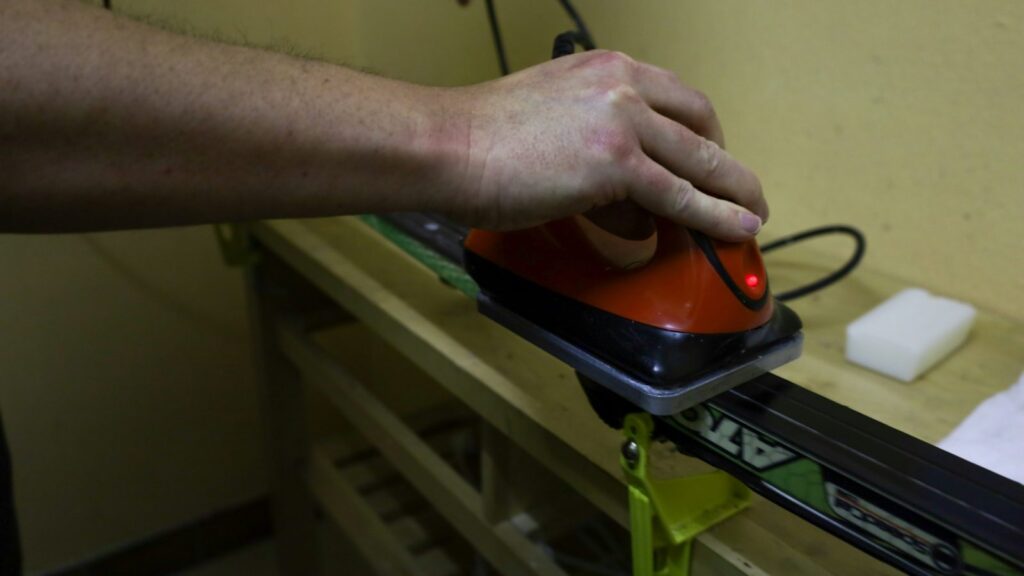
Why do skis need wax?
A ski base is made of porous plastic – polyethylene. Wax soaks into its pores and creates a surface that favors gliding. When the wax is gone, the base dries out, turns grayish, starts to „grab” the snow and wears down faster, especially near the edges, where friction is greatest.
- better glide – less braking on flat spots and flat sections;
- easier handling – a well-waxed ski glides more evenly and turns more easily;
- base protection – wax protects the base from drying out and minor scratches;
- less fatigue – your energy goes into turns, not into pushing.
A well-waxed ski is like an inflated car tire: you can drive on a flat one too, just harder and slower.
How we wax at the workshop
- Cleaning. We remove dirt and old, contaminated wax – otherwise the new wax wouldn’t soak in.
- Choosing the wax. We take into account the snow temperature, snow type and where you’re headed – the Alps, Scandinavia or Lithuanian slopes.
- Melting in. We melt the wax in evenly so that it soaks into the base across its entire width.
- Scraping. We let the wax harden and remove the excess – only what has soaked in stays on the base.
- Polishing. We polish the surface with automatic tools – the glide is smoother and the wax lasts longer.
With double waxing and the PREMIUM service, the wax is melted in twice: the first layer saturates the base, the second forms a longer-lasting glide layer.
Which wax for which snow?
The colder and drier the snow, the sharper its crystals – it requires a harder wax. Warm, wet snow suits a softer wax. The approximate scale looks like this:
| Snow temperature | Wax (approximate color) | When you encounter it |
|---|---|---|
| 0…+10 °C | yellow | spring in the mountains, wet snow |
| −4…0 °C | red | thaw, damp snow |
| −8…−4 °C | purple | most common winter conditions in the mountains |
| −14…−8 °C | blue | cold days, dry snow |
| colder than −14 °C | green | very cold, high mountains, north |
Artificial snow is more abrasive than natural snow, so a wax one step harder is usually chosen for it. The exact ranges vary by wax manufacturer – at the workshop we will choose the wax to suit your trip. Give it a try:
Wax thermometer
What will the snow temperature be on your trip?
Approximate scale – exact ranges vary by wax manufacturer. At the workshop, we'll choose based on where you're traveling and the snow conditions.
Waxes by purpose
- For everyday skiing and training – an economical universal all-temperature wax suitable for most conditions.
- For indoor slopes and icy surfaces – a paraffin-free all-temperature wax.
- For racing and wet snow – temperature-specific waxing in two or even three layers: base wax, temperature wax and speed powder.
How often should you wax?
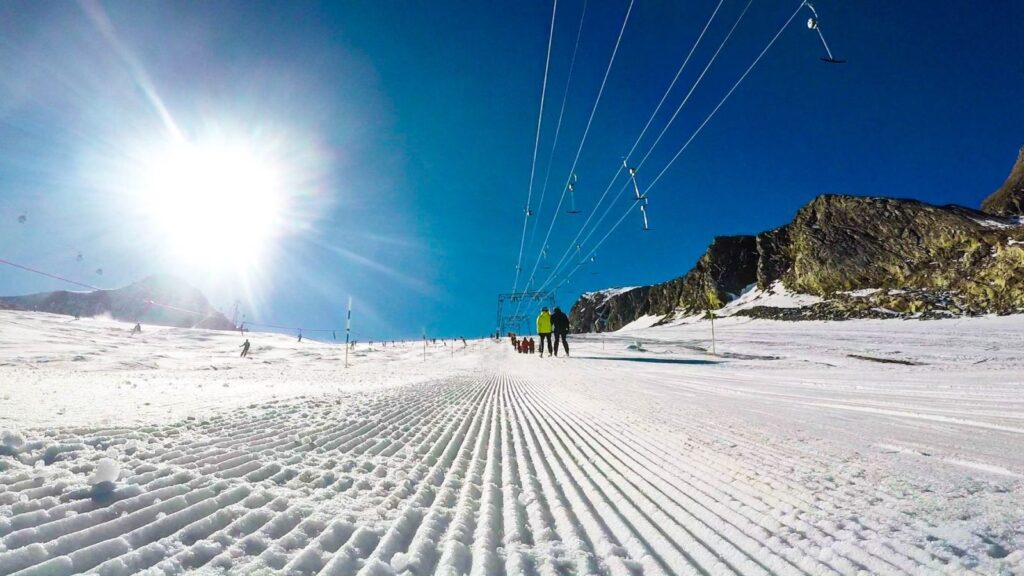
With recreational skiing in the mountains, wax wears off after roughly 3–5 days of skiing – faster on artificial or icy snow, slower on soft natural snow. A simple rule: if the base next to the edges has turned greyish and dry, it is time to wax. Before a week-long trip, choose double waxing or PREMIUM preparation.
Wax is useful even when you are not skiing: before summer, a base covered with a thick layer of wax does not dry out, and the edges do not rust. That is what storage waxing is for.
Waxing prices
Alpine skis
- Waxing without sharpening (waxing + polishing)14 €
- Double waxing without sharpening (waxing + polishing)24 €
Snowboard
- Waxing without sharpening (waxing + polishing)19 €
- Double waxing without sharpening (waxing + polishing)29 €
Cross-country skis
- Cross-country ski service STANDARD (waxing + polishing)14 €
Waxing together with edge sharpening is included in the full-service packages: from 22 € for skis, from 27 € for a snowboard. Learn more about ski service and snowboard service.
Frequently asked questions
What is the difference between waxing and double waxing?
In double waxing, the wax is melted in twice, so the base is saturated better and the glide lasts longer. For skis, waxing costs 14 €, double waxing – 24 €.
Can I wax my skis at home?
You can, if you have a waxing iron, a scraper and brushes. However, at the workshop the wax is melted in evenly, the excess is removed and the base is polished – the result lasts longer, and there is no risk of overheating the base.
Do new skis need to be waxed?
Most often, yes. New skis from the factory are coated with a thin protective wax that wears off quickly. Before your first trip it is worth waxing them and checking the edge angle.
Do you wax cross-country skis?
Yes. Cross-country ski service (waxing and polishing) costs 14 €. Learn more about cross-country ski service.